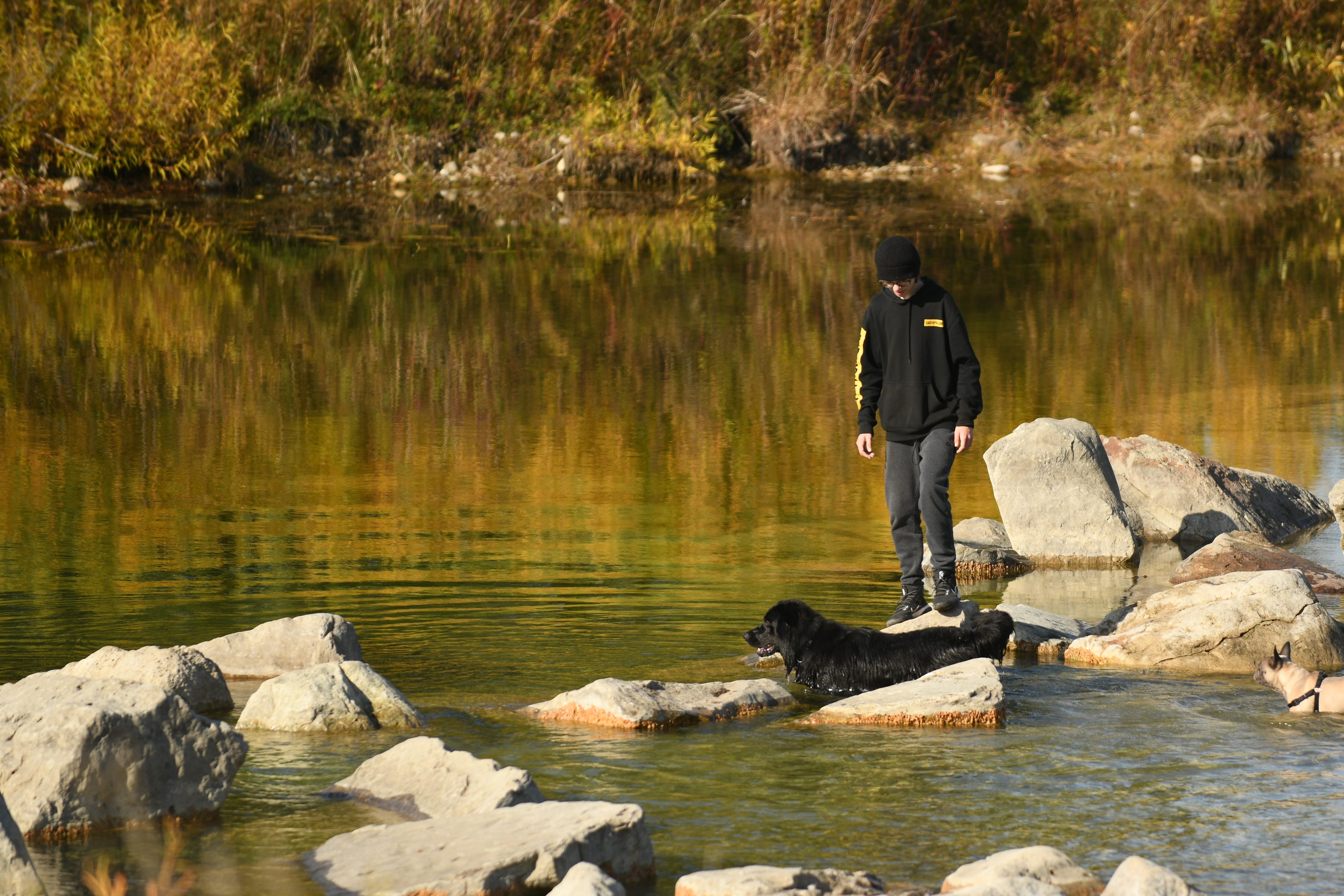
It’s a quiet Sunday afternoon in late October at Snyder’s Flats. People are soaking up what could be the last warm day of the season. They’re fishing, canoeing, hiking, and, of course, walking their dogs. The dogs are off-leash, frolicking on the path, in the grass, among the trees and in the ponds.
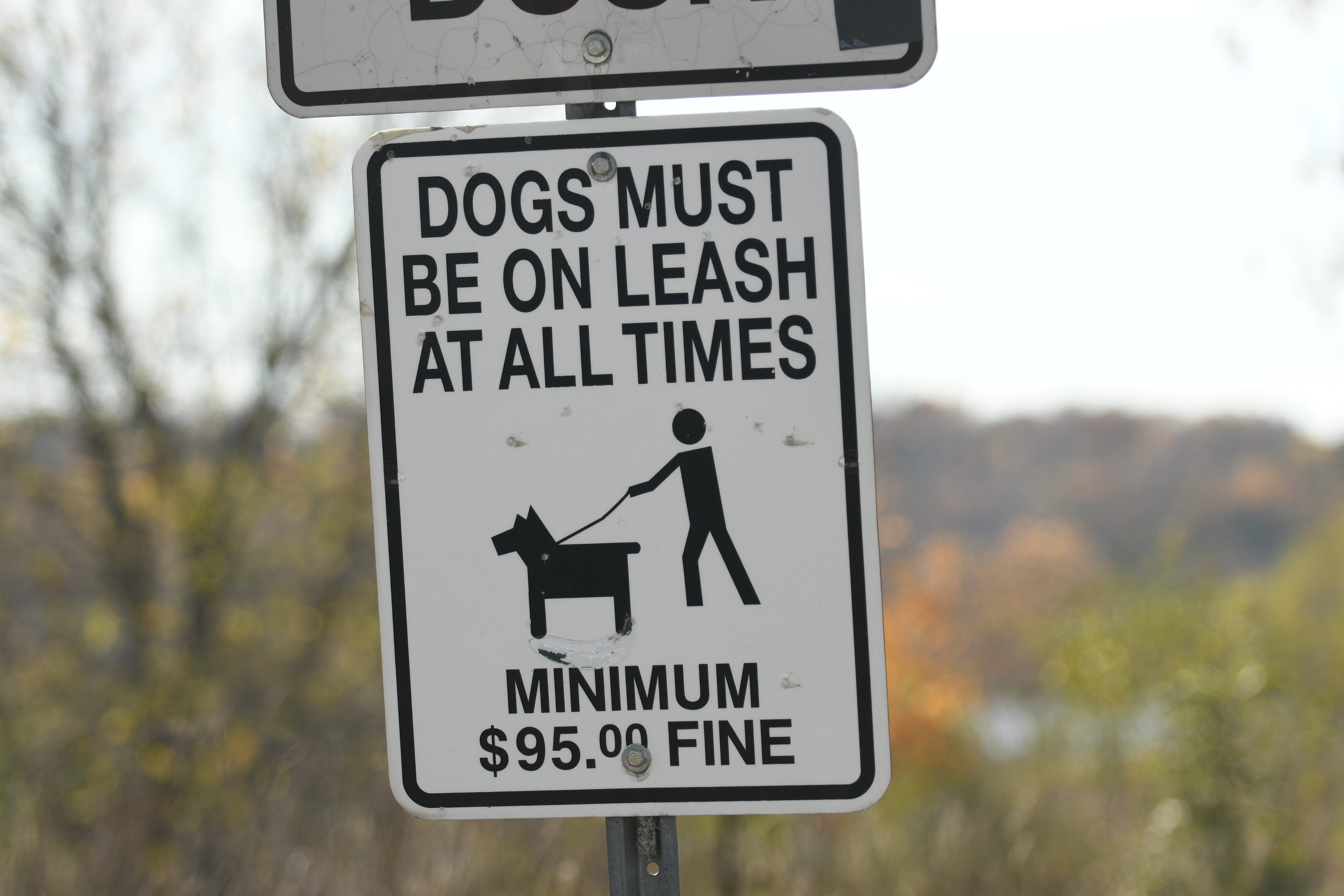
Snyder’s Flats is known as an unofficial off-leash dog park in the Region of Waterloo, but Grand River Conservation Authority staff are working to change that perception. This is because off-leash dogs are detrimental to the area’s primary purpose: to be a demonstration site for better gravel pit practices and finding the best ways to restore former gravel pit sites.
A little side note about gravel pits in Ontario
Cleaning up after gravel pits is a longstanding issue in the province. Ontario is littered with thousands of old aggregate sites that are a burden on the taxpayers saddled with them. A demonstration site to develop and show best practices that actually work to rehabilitate gravel pits into ecologically thriving sites would go a long way in solving this problem – both the legacy pits leftover, and future ones.
So where were we? Oh yes, the Flats!
The Snyder’s Flats site was owned by the Snyder family beginning in 1807 when Jacob Snyder, an emigrant from Pennsylvania, settled there. The property stayed in the family until 1969 when the GRCA bought it from Raymond Snyder for 200,000 dollars. In 1979, the GRCA worked with a local aggregate producer to open the site for gravel mining.
The GRCA imposed two conditions on the gravel extraction: that the gravel be extracted and then the pits rehabilitated in five-acre strips, one at a time, and that the extraction stayed 50 feet from the normal river bank.
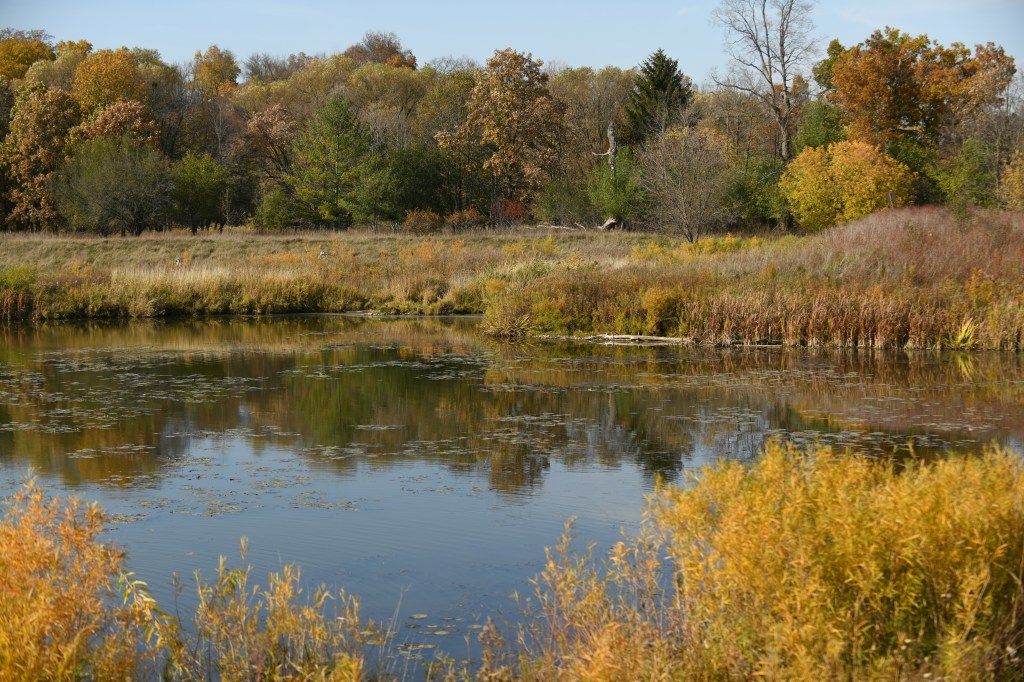
Over the eight years the site was in production, the pits were dug below the water table and they naturally filled with water. The plan was for these filled ponds to function like the floodplain pools that had once formed in the flats during times of flood in the spring and fall. Flooding of the area used to last for about three weeks. Now, due to the altered nature of the surrounding land and resulting interference of natural river recharge, flooding only lasts about ten days so these pools no longer form. Fish species that use the floodplain pools for spawning are no longer able to do that at Snyder’s Flats — without some help that is.
Today the north floodplain pool connects to the Grand River by an inlet control structure put in place by the GRCA. Here, the pools fill with water during high flood times. There is also a flood channel which connects some of the pools to ensure fish can travel between them and into the river.
The GRCA staff also installed some green infrastructure to see how well plant material works to stabilize areas that are likely to erode. Other pools became warm water fish habitat. They connect to the Grand River via backwater flooding during the spring and fall floods. Besides working on the ponds and flooding infrastructure, tens of thousands of trees were planted, along with a grassland prairie and wetland complex, among other projects. All of this work was done with many, many partner organizations and volunteers.
All this sounds cool and all, but what does my dog have to do with it?
The purpose of Snyder Flats is to be a rehabilitation site for aquatic and terrestrial ecosystems, where rehabilitation methods can be tested for how well they work. One of the main indicators of rehabilitation success is the return of biodiversity—that is, animals and plants and all kinds of life forms repopulating the area naturally.
The presence of domestic dogs is shown to reduce an area’s biodiversity. Sad, but true. Multiple studies confirm that dogs have a negative impact on wildlife, especially when human and canine activity happens off formal trails. The implications for off-leash dogs are even worse.
In one eyebrow-raising study from 2007, a 35 percent decline in bird diversity happened in areas where there was dog walking. Not only that, but for the species that were present, their abundance declined by 41 percent. This study also showed that the effects of dogs were evident even in areas where dog walking happened frequently, meaning that wildlife does not “get used” to the presence of dogs. Off-leash dog walking has also been shown to disturb some shore birds from their nests.
This disturbance of flora and fauna and the resulting decrease in biodiversity caused by off-leash dogs is actively detracting from the GRCA’s original goals for the Snyder’s Flats Rehabilitation Project: that it would be a site where best practices for gravel pit rehabilitation can be tested and developed. The disturbance and resulting decrease to biodiversity is negatively skewing the results of the rehabilitation and aggregate methods testing.
So what can be done?
It’s hard to believe on this sunny afternoon, while watching dogs have so much fun in the ponds and in the fields and trees, that they are negatively impacting biodiversity. But it’s proven that dogs induce prey-avoiding actions in wild animals – we want to attract species-at-risk to the area, not scare them away.
In 2015, the GRCA met to decide on the management plan for Snyder’s Flats for the next ten years. Staff decided to continue the Snyder’s Flats Rehabilitation Project. Too much work had already been put into the project since it began in the 1980s, and the possible results from the project too important to just drop.
This means the GRCA is asking visitors to keep their dogs on a leash under two meters (six feet) long, and stay on the formal trail system when visiting Snyder’s Flats, including keeping dogs out of the ponds. The ponds are meant to be habitat for fragile fish species that rely on the sheltered ponds for the success of their young. There aren’t that many places left in the area where these fish can breed successfully.
Keeping dogs on-leash, and on the formal trails will leave plenty of space for the at-risk plants, trees, insects, fungi, birds, fish, animals and all forms of life that the GRCA is hoping to attract back to the site. We can all help out with this work, and all be proud of it.
 Leah Gerber